Table of Contents
ToggleOutdoor smart locks aren’t just for front doors anymore. They’re showing up on gate latches, shed doors, garage side entries, and pool house access points, anywhere you want keyless control without weathering headaches. The tech has matured: battery life stretches past a year, encryption standards have tightened, and installation rarely requires rewiring. But choosing the right lock means understanding IP ratings, connectivity protocols, and whether your exterior door prep can handle a retrofit. This guide walks through what makes an outdoor smart lock work, what features matter most, and how to install one without hiring out the job.
Key Takeaways
- Outdoor smart locks eliminate fumbling for keys while providing remote access, activity logs, and temporary codes for guests—all without rewiring your door.
- Battery life for outdoor smart locks typically lasts 8–18 months depending on power source and usage, with many models offering low-battery alerts and emergency jump-start ports.
- IP65-rated seals protect outdoor smart locks from weather damage in exposed entryways, while stainless steel construction resists corrosion in salt-air coastal climates.
- Most outdoor smart locks install in 20–40 minutes without professional help, as they fit standard door prep dimensions and include a manual override to meet egress code requirements.
- Smart home integration lets your outdoor smart lock trigger automations like adjusting thermostats or floodlighting when the door unlocks, supported by Alexa, Google Home, and HomeKit platforms.
- Entry-level outdoor smart locks start around $120–$150, while premium models with biometric sensors and Grade 1 security run $280–$350, making them accessible across different budgets.
What Is an Outdoor Smart Lock and How Does It Work?
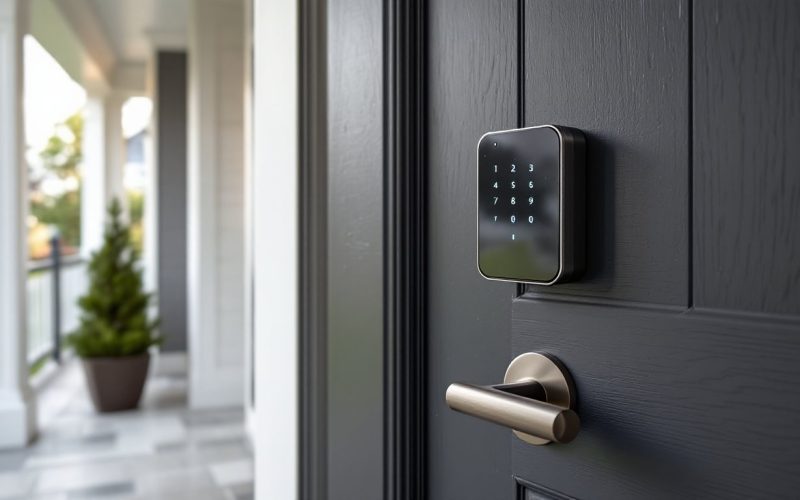
An outdoor smart lock replaces or supplements a traditional deadbolt with a motorized mechanism controlled via smartphone app, keypad, fingerprint scanner, or voice assistant. The “outdoor” designation signals ruggedized construction: sealed electronics, corrosion-resistant housings, and weatherproof gaskets that keep rain, dust, and temperature swings from bricking the device.
Most models mount to a standard door prep, a 1-inch or 1-3/8-inch cross-bore and a 2-1/8-inch or **2-3/8-inch faceplate mortise, making them compatible with existing deadbolt cutouts. The exterior assembly usually houses the keypad or biometric scanner, while the interior holds the motor, batteries (typically four AA or a rechargeable lithium pack), and manual thumb-turn override.
Connectivity varies: Wi-Fi locks connect directly to your router, Bluetooth models pair with your phone at close range, and Z-Wave or Zigbee units require a smart home hub. Some use a hybrid approach, pairing Bluetooth for setup and Wi-Fi for remote access. When you unlock via app, the command travels through your network, authenticates against the lock’s encryption key, and triggers the motor to retract the bolt. Response time typically clocks under two seconds with a strong signal.
Key Benefits of Installing an Outdoor Smart Lock
Keyless entry tops the list. No more fumbling for keys with groceries in hand or hiding a spare under a fake rock. Temporary access codes let contractors, dog walkers, or Airbnb guests in without duplicating physical keys, and you can revoke those codes remotely the moment the job wraps.
Activity logs record every unlock, whether via code, app, or manual thumb-turn. That visibility helps track who came home when, and some locks send push notifications in real time. If your teenager swears they got home by curfew, the log settles the debate.
Integration with smart home ecosystems turns your lock into a trigger. Pair it with a smart thermostat to adjust temperature when you unlock at 6 p.m., or sync it with outdoor lighting so the porch floods with light the moment the deadbolt retracts. Platforms like Amazon Alexa, Google Home, and Apple HomeKit support these automations, just confirm compatibility before buying.
Weather resilience means no frozen cylinders in January. Traditional pin-tumbler locks can jam when moisture seeps in and ices over. A sealed smart lock with an IP65 rating or higher shrugs off rain, snow, and humidity without losing function. Battery-powered operation also sidesteps wiring hassles, though you’ll need to swap cells or recharge annually depending on usage.
Top Features to Look for When Choosing an Outdoor Smart Lock
Weather Resistance and Durability Ratings
IP ratings (Ingress Protection) tell you what a lock can withstand. The first digit rates dust ingress (0–6), the second covers moisture (0–9). An IP54 lock handles splashing water but not sustained jets: IP65 resists low-pressure water jets from any direction and keeps out all dust. For covered porches, IP54 suffices. Exposed entryways, side gates, outbuilding doors, coastal installations, demand IP65 or better.
Check the operating temperature range. Budget locks often spec 0°F to 120°F, which sounds wide until a polar vortex hits or your black metal door bakes at 140°F in Arizona sun. Premium models operate from -22°F to 140°F or beyond. Corrosion resistance matters in salt-air climates: look for stainless steel or zinc alloy housings with anodized or powder-coated finishes.
Battery specs vary. Alkaline AA packs typically last 8–12 months with moderate use (10–15 unlocks daily). Rechargeable lithium cells stretch that to 12–18 months but cost more upfront. Some locks include low-battery alerts 30 days out and offer emergency jump-start ports, usually a 9V terminal hidden under the keypad so a standard 9V battery can fire up the lock long enough to get inside.
Connectivity Options and Smart Home Integration
Wi-Fi locks offer the most convenience: no hub required, remote access from anywhere, instant firmware updates. They drain batteries faster, expect 6–9 months per charge, and require a strong signal at the door. If your router sits two floors away, consider a Wi-Fi extender or mesh system.
Bluetooth models conserve power and cost less but limit control to ~30 feet. You can’t unlock from the office, but you can trigger it from the driveway. Some Bluetooth locks support auto-unlock, sensing your phone’s approach and retracting the bolt as you reach the door, handy but slightly creepy the first few times.
Z-Wave and Zigbee protocols lean on a hub (SmartThings, Hubitat, Home Assistant). They’re power-efficient, secure, and mesh well with other smart devices, but setup complexity rises. If you already run a hub, they’re ideal. Starting from scratch? Wi-Fi simplifies the stack.
Voice control support varies. Amazon Alexa and Google Assistant integrate broadly, but Apple’s HomeKit maintains stricter certification, fewer models qualify. Note that voice unlocking often requires a verbal PIN (“Alexa, unlock the front door, PIN 1234”) to prevent passersby from shouting commands. Advanced models showcased at events like CES increasingly feature multi-factor authentication and enhanced biometric options.
How to Install an Outdoor Smart Lock (DIY Step-by-Step)
Most outdoor smart locks install in 20–40 minutes with basic tools. Always wear safety glasses when drilling and confirm your door’s backset and bore dimensions before ordering.
Tools & Materials:
• Phillips and flathead screwdrivers
• Tape measure
• Drill with 1/8-inch and 2-1/8-inch hole saws (if modifying bore)
• Chisel and hammer (for mortise adjustments)
• Pencil
• Outdoor smart lock kit (includes lock body, strike plate, mounting hardware, batteries)
Steps:
-
Remove the existing deadbolt. Unscrew the interior thumb-turn assembly first, then the exterior cylinder. Pull both halves free and set aside the old strike plate.
-
Check the door prep. Measure the backset, the distance from the door edge to the center of the bore. Standard residential doors use 2-3/8 inches or 2-3/4 inches. Verify the cross-bore diameter matches your lock (usually 2-1/8 inches). If your old lock left a larger hole, some smart locks include adapter rings: otherwise, you may need a conversion kit or wood filler and a fresh bore.
-
Install the exterior assembly. Thread the tailpiece (the square spindle) through the cross-bore. Align any cable or connector per the instructions, some models use a ribbon cable, others rely on direct contact pins. Secure the exterior escutcheon with the provided screws, but don’t overtighten: metal threading into composite materials can strip.
-
Attach the interior assembly. Slide it onto the tailpiece, ensuring the motor housing clears the door edge. Most units have an alignment notch or guide. Fasten with mounting screws, checking that the thumb-turn rotates freely without binding.
-
Install the strike plate. If the old plate fits the new bolt, reuse it. Otherwise, chisel out the mortise to match the template, drill pilot holes for screws, and secure the strike. Use 3-inch wood screws that bite into the door frame’s stud, not just the trim, this anchors the lock against kick-in attempts.
-
Insert batteries and pair the lock. Load batteries per polarity markings. Download the manufacturer’s app, create an account, and follow the pairing flow, usually a button press on the lock followed by Bluetooth or Wi-Fi handshake. Set your master code and test all entry methods (app unlock, keypad code, manual thumb-turn).
-
Test from both sides. Lock and unlock a dozen times, checking for smooth operation. If the bolt sticks, adjust the strike plate vertically or horizontally using the slotted screw holes.
Permit & Code Notes: Replacing a lock is cosmetic work and rarely requires a permit. But, if you’re cutting a new door bore or modifying a fire-rated door in a commercial building, check local codes. The International Residential Code (IRC) doesn’t regulate lock types, but it does mandate egress, smart locks must include a manual override (thumb-turn) on the interior side to satisfy emergency exit requirements.
If your door has a complex multi-point locking system or you’re working with a metal security door, consider a locksmith consult. Those setups often require shimming or custom adapters.
Best Outdoor Smart Lock Options for Different Entry Points
Front and back doors: Full-size smart deadbolts with keypads offer the best balance of security and convenience. Look for ANSI/BHMA Grade 1 or Grade 2 ratings, Grade 1 withstands 800,000 cycles and six strikes from a 75-pound hammer. Models with anti-pick shields and reinforced strike plates deter forced entry. For coastal or high-humidity areas, prioritize stainless steel construction and IP65 seals.
Side gates and fence doors: These entries often use rim latches or surface-mount deadbolts rather than bore-through hardware. Smart padlock-style or deadbolt retrofit kits work well here. Choose a lock with auto-lock after a set interval, gates left ajar invite critters and trespassers. Solar-rechargeable models exist but verify they get enough sun: shaded gates are better served by AA batteries.
Garage side doors and workshops: If the door already has a keyed knob or lever, a smart deadbolt adds security without replacing the knob. Some contractors prefer keypad-only models without Bluetooth or Wi-Fi to avoid connectivity troubleshooting in detached structures. Alternatively, a Z-Wave lock paired with a hub in the main house can bridge the gap if Wi-Fi range falls short.
Sheds and outbuildings: Lightweight doors with minimal framing won’t support a heavy motorized deadbolt. Consider a smart padlock with a weatherproof shackle or a hasp-mounted smart latch. These typically offer Bluetooth-only connectivity and shorter battery life (6–8 months) but install without drilling a cross-bore. According to reviews on platforms like CNET, smart padlocks suit low-security applications but aren’t a substitute for hardened deadbolts on primary entries.
Pool houses and cabanas: Moisture and chlorine vapor accelerate corrosion. Stainless or marine-grade locks fare best, and frequent rinsing extends lifespan. If the structure lacks power, battery-only locks simplify installation. For shared spaces, temporary codes prevent the hassle of distributing physical keys to guests, just generate a code that expires at checkout. Resources like Digital Trends regularly update guides on smart home devices for outdoor and high-moisture environments.
Price and reliability: Entry-level outdoor smart locks start around $120–$150 (often Bluetooth-only, plastic housings, basic weather sealing). Mid-tier models ($180–$250) add Wi-Fi, metal construction, and IP65 ratings. Premium units ($280–$350) bring biometric sensors, Grade 1 security, extended temperature ranges, and hub integration. Prices fluctuate with supply-chain shifts and regional demand, so confirm current rates before budgeting.
Before buying, verify your door’s material and thickness. Hollow-core doors flex under load and won’t hold a deadbolt securely, reinforce with a steel strike box or upgrade to a solid-core door. Metal and fiberglass doors handle smart locks well, but check that screws won’t bottom out in thin skins.