Table of Contents
TogglePlanning an outdoor kitchen is more than stacking stone and dropping in a grill. It’s spatial design, material selection, plumbing and gas runs, electrical code compliance, and weatherproofing, all wrapped into one permanent structure. Unless you’ve installed a few dozen kitchens yourself, it’s worth hiring someone who has. A professional outdoor kitchen designer brings field experience, trade connections, and the ability to turn a Pinterest board into a buildable plan that won’t leak, rust, or fall apart in three years. This guide walks through what to look for, where to find designers, and how to vet them before you commit.
Key Takeaways
- Hiring a professional outdoor kitchen designer ensures proper spatial planning, code compliance, and weatherproof construction that prevents costly repairs and permit issues down the road.
- A qualified outdoor kitchen designer should have a portfolio of at least three completed projects, licensed subcontractors, liability insurance, and proven experience with local building codes and trade-specific challenges.
- Mid-range custom outdoor kitchen projects typically cost $20,000–$40,000, with designer fees ranging from 10–20% of total project cost for full-service design-build or $2,000–$5,000 for design-only services.
- Ask potential outdoor kitchen designers specific questions about timeline (8–12 weeks is realistic), permit handling, 3D renderings, material specifications, and warranty coverage before committing to a contract.
- Find reputable outdoor kitchen designers through trade platforms like Houzz, local landscape architects, material suppliers, and home shows, while avoiding general handyman services lacking specialized outdoor kitchen experience.
- Budget 10–15% contingency into your outdoor kitchen project to cover site surprises like hidden utilities, soil issues, or shipping damage to high-end appliances.
Why Hire a Professional Outdoor Kitchen Designer?
An outdoor kitchen sits at the intersection of carpentry, masonry, plumbing, electrical, and finish work. Most homeowners can handle a paver patio or a simple deck, but a built-in kitchen involves utility connections, weatherproof cabinetry, and code-compliant ventilation. Designers coordinate trades, source weather-resistant materials, and catch problems before they turn into expensive fixes.
Spatial planning is where DIY often falls short. Counter height, grill clearance, hood placement, and work triangle flow all affect usability. A designer knows the difference between nominal and functional space, for example, a 36-inch grill needs at least 48 inches of counter clearance on the hot side for safe plating. They also account for wind patterns, sun exposure, and drainage, which are rarely considered in a quick backyard sketch.
Permit navigation is another reason to bring in a pro. Most jurisdictions require permits for gas lines, electrical circuits over 20 amps, and permanent structures over a certain square footage (often 120 square feet). Designers familiar with local codes can expedite approvals and ensure inspections pass the first time. Skipping permits might save money upfront, but it can torpedo a home sale or trigger costly retroactive work.
Finally, designers have access to trade pricing on appliances, stone, and cabinetry that aren’t available at big-box stores. They also know which brands hold up outdoors, outdoor living spaces demand materials that resist UV, moisture, and temperature swings far better than indoor equivalents.
What to Look for in an Outdoor Kitchen Designer
Not all designers are created equal. Some specialize in high-end custom builds: others focus on modular kits. Matching your project scope to their expertise avoids miscommunication and budget creep.
Experience and Portfolio
Ask for a portfolio that includes at least three completed outdoor kitchens similar in scale and style to yours. Look for variety in materials (stone veneer, stucco, steel framing), appliance types (built-in grills, pizza ovens, refrigeration), and site challenges (slopes, small yards, proximity to the house). A designer who’s only done flat, sprawling properties may struggle with a compact urban patio.
Check for finished photos, not just renderings. Computer models look great, but they don’t show how grout lines weather, how cabinet doors align after a wet winter, or whether the layout actually flows during a cookout. If possible, ask for references and visit a completed project in person. Pay attention to details like caulk lines, drawer operation, and whether the stone veneer is already delaminating.
Years in business matter, but so does project volume. A designer who completes two kitchens a year for ten years has twenty builds under their belt, that’s real experience. Someone who just pivoted from interior design last year may have a great eye but lacks the field knowledge to troubleshoot a tricky gas line run or a drainage issue. According to professionals who specialize in outdoor spaces, collaborating with landscape architects and contractors is often essential for complex installations.
Licensing, Insurance, and Certifications
Licensing requirements vary widely. Some states require a contractor’s license for any work over $500: others regulate only specific trades (plumbing, electrical, gas). A designer who doesn’t hold a general contractor’s license should have a clear network of licensed subs they regularly work with. Ask who’s pulling permits and who’s legally responsible if something goes wrong.
Liability insurance and workers’ compensation are non-negotiable. Request certificates of insurance (COI) before any work begins. If an uninsured worker is injured on your property, you could be held liable. Standard homeowner’s policies often don’t cover contractor injuries, so verify coverage directly with the insurer, not just the designer.
Certifications like Certified Outdoor Kitchen Designer (COKD) or National Kitchen & Bath Association (NKBA) credentials indicate specialized training, but they’re not required for competence. What matters more is whether the designer understands the National Electrical Code (NEC) requirements for GFCI-protected outdoor circuits, IRC load-bearing standards for overhead structures, and local amendments that might restrict gas appliance placement near property lines.
Where to Find Qualified Outdoor Kitchen Designers
Start with trade-specific platforms like Houzz, which allows filtering by project type, location, and budget. Read reviews carefully, look for mentions of communication, timeline accuracy, and post-installation support. A five-star rating based on two jobs isn’t as useful as a 4.5 average across fifty projects.
Local landscape architects often have outdoor kitchen designers on staff or can recommend specialists they’ve collaborated with. Since kitchens need to integrate with hardscaping, plantings, and drainage, a designer who already works with your landscape team can streamline coordination. Regional design magazines like Sunset and Southern Living frequently feature outdoor projects and list the designers behind them.
Material suppliers are an underused resource. Showrooms that sell outdoor cabinetry, stone, or high-end grills often maintain lists of designers who regularly spec their products. These designers know the material inside and out, how it installs, how it ages, and what it costs at different quality tiers. It’s similar to how a quality covered outdoor space requires careful material selection for long-term durability.
Home shows and builder expos let you see work samples in person and meet designers face-to-face. Bring photos of your site, rough measurements, and a ballpark budget. A designer who immediately starts problem-solving or asks clarifying questions is worth a follow-up call. One who hands you a brochure and moves on probably isn’t interested in your project scale.
Avoid general handyman services advertising outdoor kitchens as an add-on. Unless they have a proven portfolio and licensed subs, you’re gambling on someone learning on your dime. Outdoor kitchens aren’t scaled-up deck builds, they require specialized knowledge that takes years to develop.
Questions to Ask Before Hiring a Designer
Interviews separate amateurs from pros. Ask specific, trade-level questions and listen for detailed answers, not sales fluff.
1. What’s your typical timeline from design to completion? A realistic answer for a mid-size kitchen (10–15 linear feet of counter, built-in grill, sink, and storage) is 8–12 weeks, assuming no permit delays. Anyone promising four weeks is either rushing or has pre-fabricated components that may not fit your site.
2. Who pulls permits, and what’s included in your fee? Some designers charge separately for permit processing: others roll it into their flat rate. Clarify whether permit fees (paid to the municipality) and plan check corrections (if the city rejects the first submittal) are included or extra.
3. Do you provide 3D renderings or just 2D plans? 3D models help visualize sightlines, scale, and material pairings. They’re especially useful if you’re deciding between stone veneer types or debating whether to add a pergola. Designers using software like SketchUp or Chief Architect can generate renderings without much upcharge.
4. What materials do you typically specify, and why? Listen for brand names and reasoning. For example, marine-grade polymer cabinetry (like WeatherStrong or Trex) resists moisture better than powder-coated steel, which can rust at fastener holes. Porcelain tile counters are more heat- and stain-resistant than concrete, which requires annual sealing.
5. How do you handle change orders? Scope creep is common, you might decide mid-build to add a side burner or upgrade to a 42-inch grill. A clear change order process with written pricing prevents surprise bills. Ask what their markup is on added materials (10–20% is standard) and whether labor charges are hourly or flat-rate.
6. What does your warranty cover, and for how long? A reputable designer should warranty their workmanship for at least one year. Appliance warranties are separate and come from manufacturers, but the designer should help any claims. Ask specifically about cabinetry joinery, stone veneer adhesion, and plumbing connections, these are the most common failure points. Companies specializing in transforming outdoor spaces often provide extended support for complex installations.
7. Can you provide references from the last 12 months? Recent references reflect current work quality and communication style. Ask past clients about responsiveness, cleanliness during construction, and whether the final cost matched the estimate.
Understanding Costs and Budgeting for Your Project
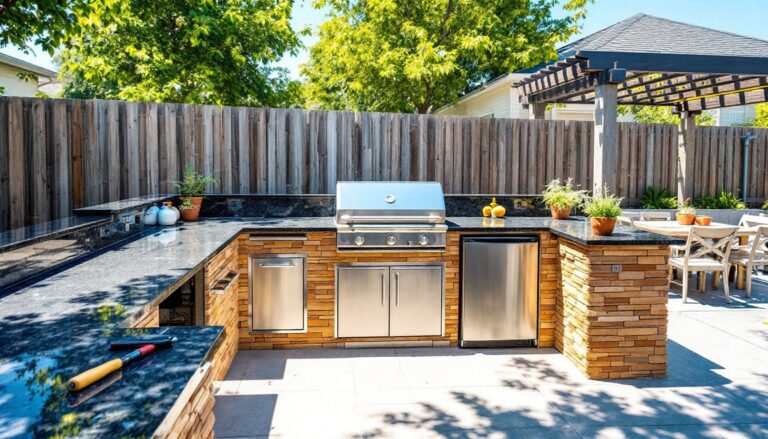
Outdoor kitchen pricing is highly variable, but understanding cost drivers helps set realistic expectations. As of 2026, a basic setup, modular grill island, concrete countertop, mini-fridge, and simple storage, starts around $8,000–$12,000 including labor. A mid-range custom build with stone veneer, built-in grill, sink with hot water, weatherproof cabinetry, and electrical runs typically lands in the $20,000–$40,000 range. High-end projects with pizza ovens, commercial-grade appliances, outdoor refrigeration, and intricate tile work can exceed $75,000.
Designer fees range from 10–20% of total project cost for full-service design-build, or a flat $2,000–$5,000 for design-only services (you hire the contractors separately). Design-build is often more efficient, the designer coordinates all trades and materials under one contract, but it limits your ability to shop labor rates. Design-only gives you flexibility but requires you to manage the build, which adds complexity if you’re juggling multiple subs.
Material costs fluctuate with market conditions. Expect $50–$150 per linear foot for stone veneer (cultured stone is cheaper than natural), $60–$200 per square foot for countertops (concrete, tile, granite, or quartz), and $1,500–$8,000 for a built-in grill depending on size and fuel type (natural gas vs. propane). Budget an additional $1,000–$3,000 for utility connections if you’re running a new gas line or 240V circuit from the main panel.
Appliances are the wild card. A basic 36-inch built-in grill runs $800–$2,000. Upgrade to a premium brand like Twin Eagles or Lynx, and you’re at $4,000–$10,000. Add a pizza oven ($2,500–$7,000 for a good wood-fired unit like Forno Bravo), kegerator ($600–$2,000), or warming drawer ($800–$1,500), and costs stack quickly. Some homeowners phase appliances in over time, install rough-ins now, add the pizza oven next year.
Permit fees vary by jurisdiction but typically run $200–$800 for a combination building/electrical/plumbing permit. Inspections can add delays (and costs) if work fails and needs correcting. Many setups incorporate features found in luxury outdoor living projects, which require coordination of multiple building systems.
Contingency is non-negotiable. Set aside 10–15% of your budget for surprises, hidden irrigation lines, unstable soil requiring deeper footings, or an appliance that arrives damaged. If you’re adding features like a portable BBQ station for flexibility, factor in those costs separately.
Always get three written estimates from designers or contractors before committing. Compare line-item pricing, not just totals. A low bid might exclude site prep, utility connections, or finish details that will cost you later. For broader inspiration, explore comprehensive outdoor transformations that integrate kitchens into larger living areas.
The right outdoor kitchen designer turns a backyard into a functional, weather-resistant cooking and gathering space that lasts decades. Vet candidates carefully, ask tough questions, and budget realistically. Done right, it’s the upgrade that makes you never want to eat indoors again.